
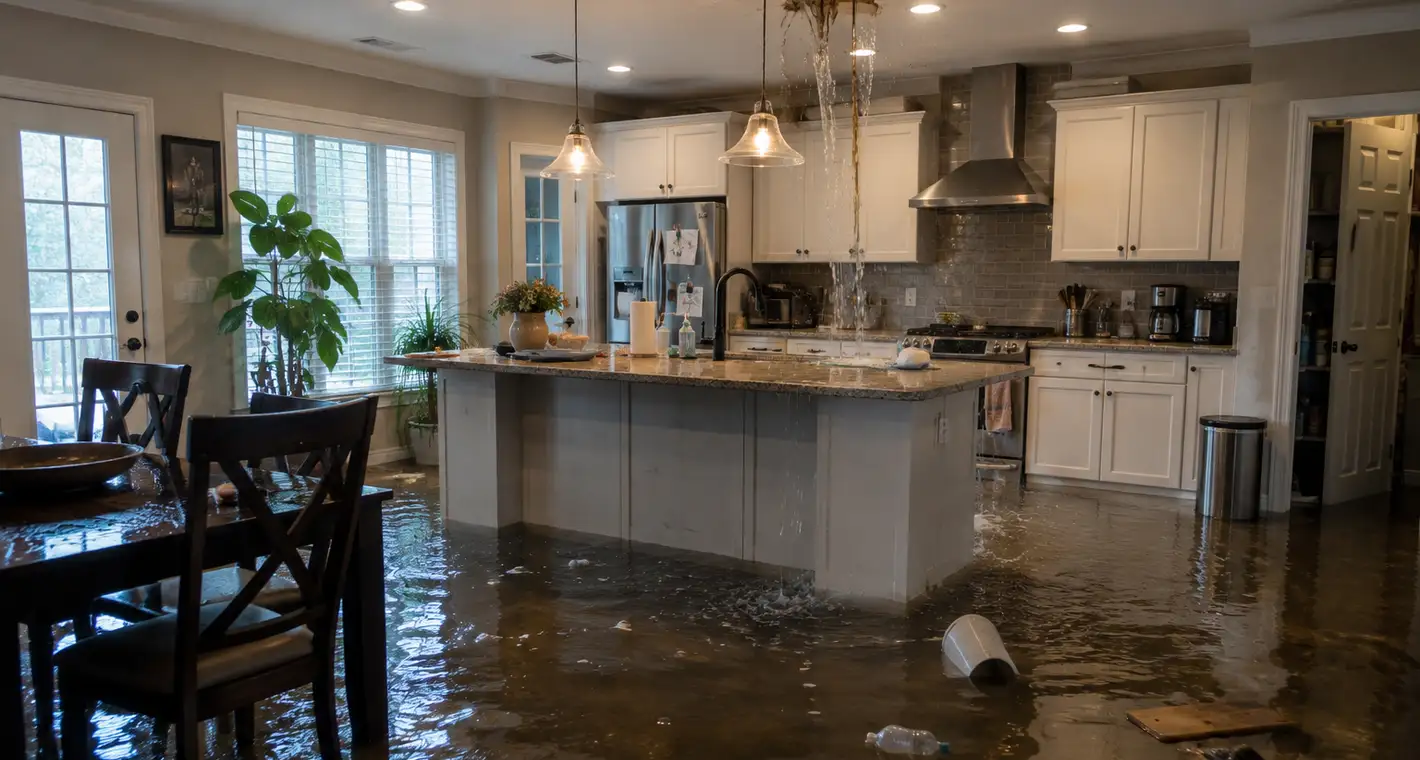
Water damage in Robinson
Robinson sits directly south of Waco on the flat ground between the Brazos River floodplain to the east and the Highway 77 corridor, with open farmland still surrounding much of the city.
The city mixes older farmhouses and 1960s ranch homes on large lots with newer slab-on-grade subdivisions filling in along the main roads, and properties on the outskirts are frequently on septic systems and private wells.
Before help arrives
- Shut the water off at the fixture or the main if you can reach it safely.
- Keep out of any room where water has reached outlets, cords, or the electrical panel.
- Lift furniture off wet carpet and move what you can to a dry floor.
- Photograph the damage and the failure point before anything is moved.
- Do not use a household vacuum to pick up standing water.
Common causes in Robinson
Proximity to the Brazos floodplain
The Brazos floodplain fans out where it passes east of Robinson, and the surrounding ground is flat enough that it drains slowly. Heavy upstream rain raises the river days after the storm has passed locally, which catches people out. Properties on the eastern side of the city and along the county roads toward the river see it first, usually as water standing across a yard with nowhere to go.
Septic systems that surcharge in saturated ground
A drain field in Blackland clay depends on a soil layer that can accept effluent. After several days of rain the clay is saturated and the field cannot absorb anything more, so wastewater backs toward the house. It surfaces at the drain closest to the floor, which in a slab home is a ground-floor tub or shower, and everything that comes back up is treated as contaminated water.
Long supply runs on larger properties
Older homes on acreage often have supply lines running well away from the structure, to a well house, a barn, livestock waterers or an irrigation point. Those runs are shallow, exposed at their ends, and easy to forget when a freeze is forecast. A break at the far end can also mask a problem closer to the house, because the pressure loss is attributed to the known failure.
Slab plumbing in mid-century construction
Ranch houses built here in the 1960s and 1970s put galvanised or early copper supply lines under the slab, and both have now been in expansive clay for over half a century. Galvanised corrodes and closes from the inside before it fails; copper thins at the bends. Either way the leak is beneath concrete, and the first sign is a warm floor, a running meter, or a damp edge along one wall.
Drying a Robinson home
Robinson properties vary far more than a subdivision street does, so the drying plan is built per house rather than per street. Older ranch homes have thinner insulation and framing that dries relatively fast once opened up, while newer sealed construction dries slowly without dehumidification. Where a septic system was involved, removal replaces drying for anything porous.
The sequence does not change from house to house: extraction first, then air movers and dehumidifiers together, with readings logged daily until materials match the dry baseline for that building. It is described in full on the water extraction and drying page.
Services available in Robinson
- Water Extraction & DryingStanding water removal and controlled structural drying under moisture readings.
- Slab Leak DamageWater surfacing through a slab-on-grade foundation, located and dried out.
- Sewage CleanupContaminated water handled with containment, removal and cleaning.
- Mold RemediationGrowth that established after water sat longer than it should have.
- Burst pipe and supply line cleanup
- Water heater and appliance leak cleanup
- Ceiling and drywall water damage
- Moisture inspection and mapping
Areas covered in Robinson
Providers cover Robinson and the surrounding area, including Old Robinson Road, Moonlight Drive, Rosenthal, Spring Valley Road, Highway 77 corridor, South Robinson and Lyndale.
ZIP codes: 76706.
Frequently Asked Questions
- Will my homeowners insurance cover water damage?
- It depends on the cause rather than the damage. Policies commonly cover sudden and accidental events such as a burst supply line or a failed water heater. Damage that developed gradually from a long-standing leak, and damage from surface flooding, are typically excluded. Photograph everything before it is moved, keep any failed part, and report the loss promptly.
- Should I turn off the electricity?
- If water has reached outlets, cords, appliances, or the panel itself, treat the area as unsafe. Only shut off the breaker if you can reach the panel without standing in water. If you cannot reach it safely, leave the area and have the utility or an electrician handle it.
- My septic backed up after heavy rain. Is that a plumbing problem or a water damage problem?
- Both, and the order matters. What came into the house is contaminated water, so the immediate work is containment, removal of affected porous material, cleaning of hard surfaces and then drying. The septic system is a separate issue: if the drain field is saturated rather than the tank being full or the line blocked, cleaning the house without reducing load on the system means it happens again with the next storm.
- I am on a well. Does that change the cleanup?
- It changes how the water source is treated afterwards. If the wellhead was submerged or the system lost pressure while contaminated water was present, the well and the household plumbing should be checked and disinfected before the water is used again. It does not change how the structure itself is dried, but it does mean the property has two separate problems to close out rather than one.
- Is there anything to do about outbuildings and the barn?
- They should be included in the walkthrough even if the house is the obvious loss. Shallow supply runs to a barn, a well house or livestock waterers are frequent freeze failures, and a break out there can keep the meter turning after the household repair is finished. If any structure holds finished space or stored contents that got wet, it needs drying on the same schedule as the house.
- The river is a mile away and my yard still flooded. How does that happen?
- Two different mechanisms produce the same result here. The Brazos floodplain is wide and flat, so a rise in the river backs water up the local drainages rather than only overtopping its banks. Separately, Blackland clay absorbs very little once it is saturated, so several inches of rain has to leave across the surface. On flat ground that surface water can stand for a day or more with the river never leaving its channel.