
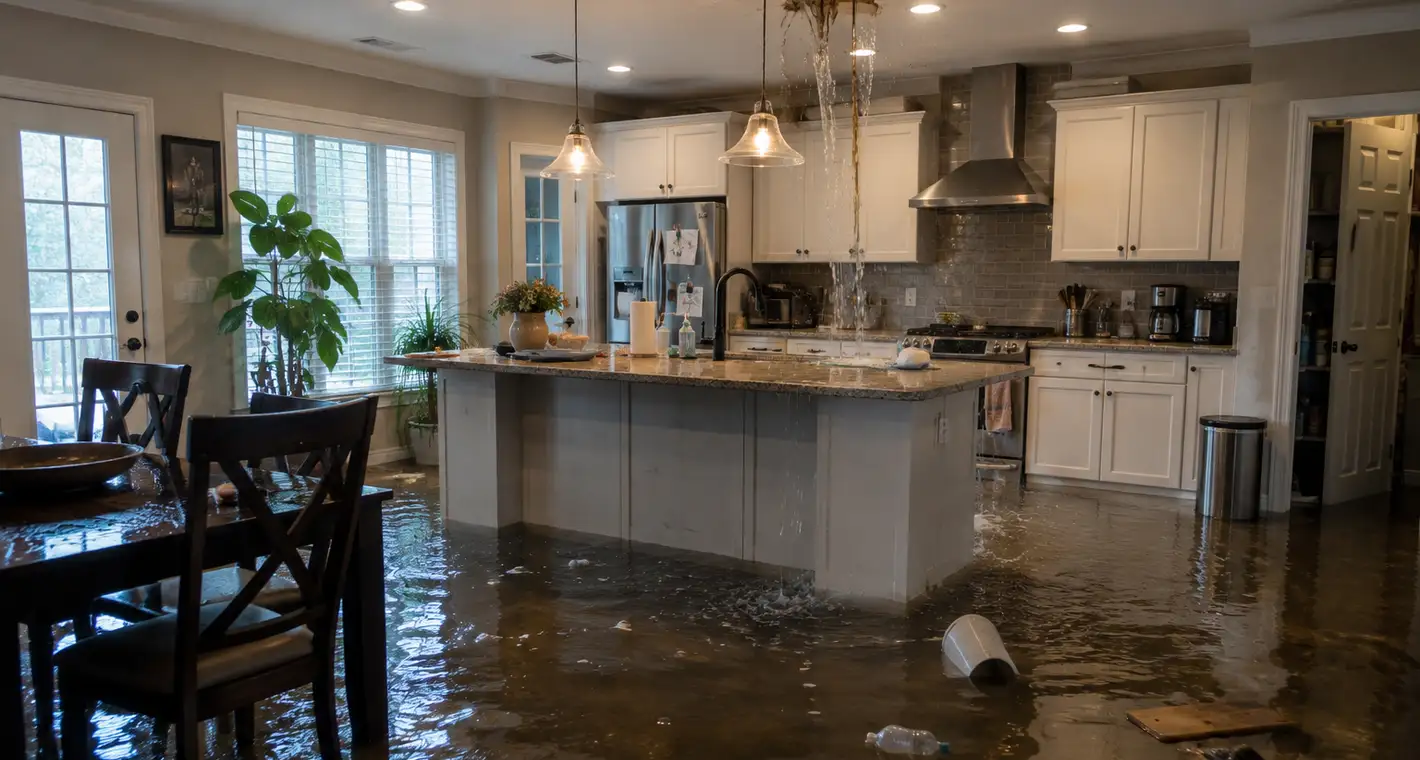
Water damage in Waco
Waco sits where the Bosque River joins the Brazos, with Lake Waco held behind a dam on the Bosque just west of the city and the Brazos floodplain widening out south of downtown.
Housing spans more than a century: pier-and-beam homes from the early 1900s through Sanger Heights, Castle Heights and Brook Oaks, mid-century building across the north and west sides, and slab-on-grade subdivisions from the 1970s onward.
Before help arrives
- Shut the water off at the fixture or the main if you can reach it safely.
- Keep out of any room where water has reached outlets, cords, or the electrical panel.
- Lift furniture off wet carpet and move what you can to a dry floor.
- Photograph the damage and the failure point before anything is moved.
- Do not use a household vacuum to pick up standing water.
Common causes in Waco
Foundation movement in Blackland clay
Waco sits on the Blackland Prairie, and the Houston Black clay underneath swells through a wet winter and shrinks back during summer drought. A slab riding that cycle moves unevenly, and copper lines cast into or running beneath it move with it. The result is often a slab leak showing as a warm spot on the floor or an unexplained jump in the water bill.
Attic air handler condensate overflow
Slab homes have no basement for mechanical equipment, so the air handler usually sits in the attic above finished rooms. Central Texas humidity keeps that coil producing condensate most of the year, and the drain line grows algae until it blocks. Once the secondary pan fills, water runs across the ceiling below and shows as a stain well away from the unit.
Freeze failures in attic and exterior-wall plumbing
Texas construction routes a great deal of supply piping through unconditioned attic space and exterior walls. February 2021 put the Waco area through roughly 205 consecutive hours below freezing, and about a third of area households reported burst pipes. Attic lines are the worst case: a failure drains through every room below before anyone reaches a shutoff.
Flash flooding off the creeks and the Brazos floodplain
Central Texas storms can put three to five inches of rain down in a few hours. Waco Creek and the smaller urban drainages fill faster than the storm sewers carry it, and the Brazos floodplain fans out across the low-lying southern edge of the city. Slab homes sit close to grade with little step up at the door, so water ponding in a street can be inside within minutes.
Drying a Waco home
Waco splits into two drying problems. Slab-on-grade homes hold water in the concrete and under tile, vinyl plank and glued-down flooring, with no crawl space to reach the underside, so readings go through the assembly and flooring is often lifted at the perimeter. The pier-and-beam blocks near downtown vent from below but hide wet subfloor and joists out of sight.
The sequence does not change from house to house: extraction first, then air movers and dehumidifiers together, with readings logged daily until materials match the dry baseline for that building. It is described in full on the water extraction and drying page.
Services available in Waco
- Water Extraction & DryingStanding water removal and controlled structural drying under moisture readings.
- Slab Leak DamageWater surfacing through a slab-on-grade foundation, located and dried out.
- Sewage CleanupContaminated water handled with containment, removal and cleaning.
- Mold RemediationGrowth that established after water sat longer than it should have.
- Burst pipe and supply line cleanup
- Water heater and appliance leak cleanup
- Ceiling and drywall water damage
- Moisture inspection and mapping
Areas covered in Waco
Providers cover Waco and the surrounding area, including Sanger Heights, Castle Heights, Brook Oaks, Provident Heights, Dean Highland, Woodland Heights, North Waco, South Waco, East Waco, Downtown, Richland Hills and Cameron Park.
ZIP codes: 76701, 76704, 76705, 76706, 76707, 76708, 76710, 76711, 76712.
Frequently Asked Questions
- Will my homeowners insurance cover water damage?
- It depends on the cause rather than the damage. Policies commonly cover sudden and accidental events such as a burst supply line or a failed water heater. Damage that developed gradually from a long-standing leak, and damage from surface flooding, are typically excluded. Photograph everything before it is moved, keep any failed part, and report the loss promptly.
- Should I turn off the electricity?
- If water has reached outlets, cords, appliances, or the panel itself, treat the area as unsafe. Only shut off the breaker if you can reach the panel without standing in water. If you cannot reach it safely, leave the area and have the utility or an electrician handle it.
- My house is on a slab. Where does water go if there is no basement?
- Sideways, mostly. Without a basement to collect in, water spreads across the slab and wicks outward into carpet padding, under vinyl plank and tile, through the tack strip into the base of the walls, and up drywall by capillary action. Because it stays thin and spread out rather than pooling, people routinely underestimate how far it has travelled, and rooms that never looked wet turn out to have saturated wall bases.
- There is a stain on my ceiling and it has not rained in weeks. What is that?
- In a Waco home that is most often the attic air handler. The evaporator coil pulls a large volume of condensate out of humid air, and when the primary drain line blocks the overflow pan takes it until it fills. Water then runs along ceiling joists and shows up as a stain that can be several rooms away from the equipment. It tends to appear during the hottest, most humid stretch of the year.
- Are older homes near downtown handled differently?
- Yes, because the construction is different. Pier-and-beam houses in Sanger Heights, Castle Heights and Brook Oaks have a ventilated space under the floor and often plaster over lath rather than drywall. Plaster reads dry at the surface while the lath behind it is still wet, so the underside of the subfloor has to be inspected directly. The clay sewer laterals common in those blocks are also prone to root intrusion.
- How do I tell a slab leak from a roof or plumbing leak in a Waco home?
- Location and timing usually separate them. A slab leak shows at floor level: a persistently damp patch of carpet or tile with no fixture above it, a section of floor that feels warm underfoot when a hot line is involved, and a meter that keeps turning with everything shut off. A roof leak follows rain and appears overhead. Condensate from an attic air handler stains a ceiling during humid weather with no rain at all.