
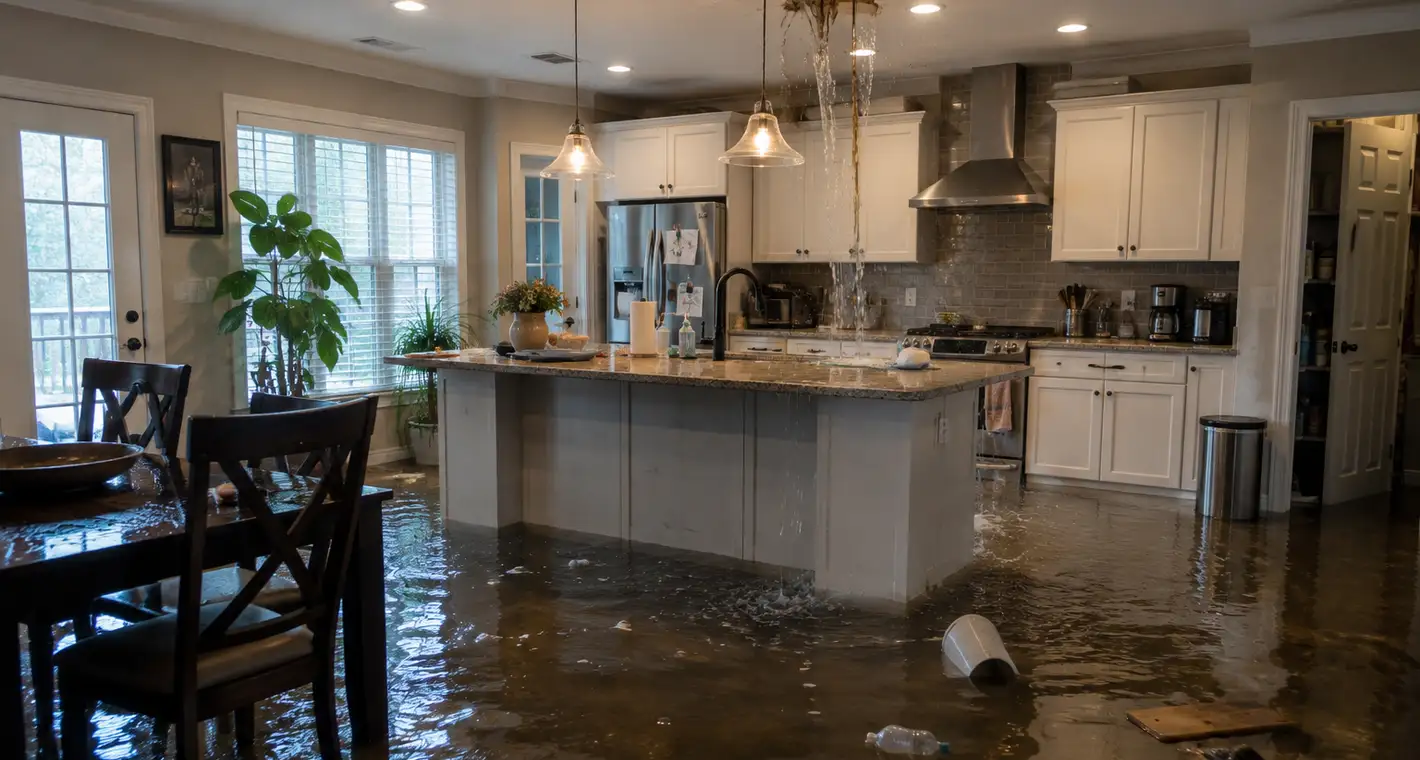
Water damage in Lorena
Lorena sits on Interstate 35 about twelve miles south of Waco, on flat Blackland Prairie farmland between Hewitt and the Bell County line.
The town holds a small older core dating to its railroad origins alongside newer slab-on-grade subdivisions and acreage homes built from the 1990s onward, with properties outside the city limits often on septic systems.
Before help arrives
- Shut the water off at the fixture or the main if you can reach it safely.
- Keep out of any room where water has reached outlets, cords, or the electrical panel.
- Lift furniture off wet carpet and move what you can to a dry floor.
- Photograph the damage and the failure point before anything is moved.
- Do not use a household vacuum to pick up standing water.
Common causes in Lorena
Deep expansive clay with nothing to break it up
The prairie ground around Lorena is deep Blackland clay with no gravel layer or rock close to the surface to moderate it. That produces the full shrink-swell range: ground that heaves through a wet winter and opens into wide cracks by late summer. A slab riding that cycle moves at the corners first, and plumbing cast into or running under it takes the strain at the joints.
Slow surface drainage on flat farmland
There is very little fall across this ground, so heavy rain leaves at the pace the ditches and culverts allow rather than the pace it arrives. Water stands in fields and along road edges for a day or more after a storm. A house set close to grade on a lot that has settled unevenly can end up with that standing water against a wall for the whole period.
Newer homes with long unoccupied stretches
Lorena functions largely as a commuter town, so many houses are empty through the working day and for longer during holidays. A supply failure in an unoccupied house runs until someone comes home. The volume passing through a broken half-inch line over eight hours is enough to turn a repairable loss into demolition of flooring, wall base and cabinetry across several rooms.
Irrigation and outdoor lines left charged into winter
On larger lots the irrigation system, the yard hydrants and the runs to outbuildings hold water year round unless they are deliberately drained. A hard freeze reaches those shallow, exposed lines first. The break itself is outside, but a backflow assembly or a line entering through a wall can put water into the structure, and it keeps running because nothing indoors indicates a problem.
Drying a Lorena home
Most Lorena housing is recent slab construction, well sealed and well insulated, which means it holds moisture rather than shedding it. Drying here depends on dehumidification more than airflow: air movers release moisture from materials, and in a tight house there is nowhere for that moisture to go unless it is actively removed from the air.
The sequence does not change from house to house: extraction first, then air movers and dehumidifiers together, with readings logged daily until materials match the dry baseline for that building. It is described in full on the water extraction and drying page.
Services available in Lorena
- Water Extraction & DryingStanding water removal and controlled structural drying under moisture readings.
- Slab Leak DamageWater surfacing through a slab-on-grade foundation, located and dried out.
- Sewage CleanupContaminated water handled with containment, removal and cleaning.
- Mold RemediationGrowth that established after water sat longer than it should have.
- Burst pipe and supply line cleanup
- Water heater and appliance leak cleanup
- Ceiling and drywall water damage
- Moisture inspection and mapping
Areas covered in Lorena
Providers cover Lorena and the surrounding area, including Old Lorena Road, Center Street, Bluebonnet Lane, I-35 frontage, Ritchie Road, Lorena Estates and Cottonwood.
ZIP codes: 76655.
Frequently Asked Questions
- Will my homeowners insurance cover water damage?
- It depends on the cause rather than the damage. Policies commonly cover sudden and accidental events such as a burst supply line or a failed water heater. Damage that developed gradually from a long-standing leak, and damage from surface flooding, are typically excluded. Photograph everything before it is moved, keep any failed part, and report the loss promptly.
- Should I turn off the electricity?
- If water has reached outlets, cords, appliances, or the panel itself, treat the area as unsafe. Only shut off the breaker if you can reach the panel without standing in water. If you cannot reach it safely, leave the area and have the utility or an electrician handle it.
- Nobody is home during the day. What reduces the risk of a long-running leak?
- The practical measures are a whole-house leak detection shutoff on the main, which closes the water when it sees continuous flow, and replacing rubber washing machine hoses with braided stainless ones, since a burst hose is one of the more common causes of exactly this scenario. Knowing where the main shutoff is, and confirming that it actually turns, matters more than any of it.
- Should the irrigation system be drained before winter?
- Yes, and so should the hose bibbs and any line running to an outbuilding. Those runs are shallow and exposed, they hold water year round unless drained, and they freeze before anything inside the house does. The break is outdoors, which is why it is easy to miss, but water can still track back into the structure through a wall penetration and it will keep running until someone closes the supply.
- Is the drying schedule different in a newer house?
- The equipment is the same but the balance shifts. A well-sealed modern house has very little natural air exchange, so moisture that air movers pull out of wet material stays in the building unless dehumidifiers take it out. Without them, humidity climbs and moisture redeposits into dry material in other rooms. In older, leakier construction some of it escapes on its own, which is not something to rely on here.
- Why does the ground here crack so badly in summer?
- Because it is deep Blackland clay with nothing underneath to moderate it. Clay of this type holds a great deal of water and shrinks substantially as it dries, so a hot dry summer opens cracks wide enough to put a hand into. The same ground swells again with winter rain. That annual movement is what stresses foundations and the plumbing cast into them, and it is the reason slab leaks are common in houses that are not old.