
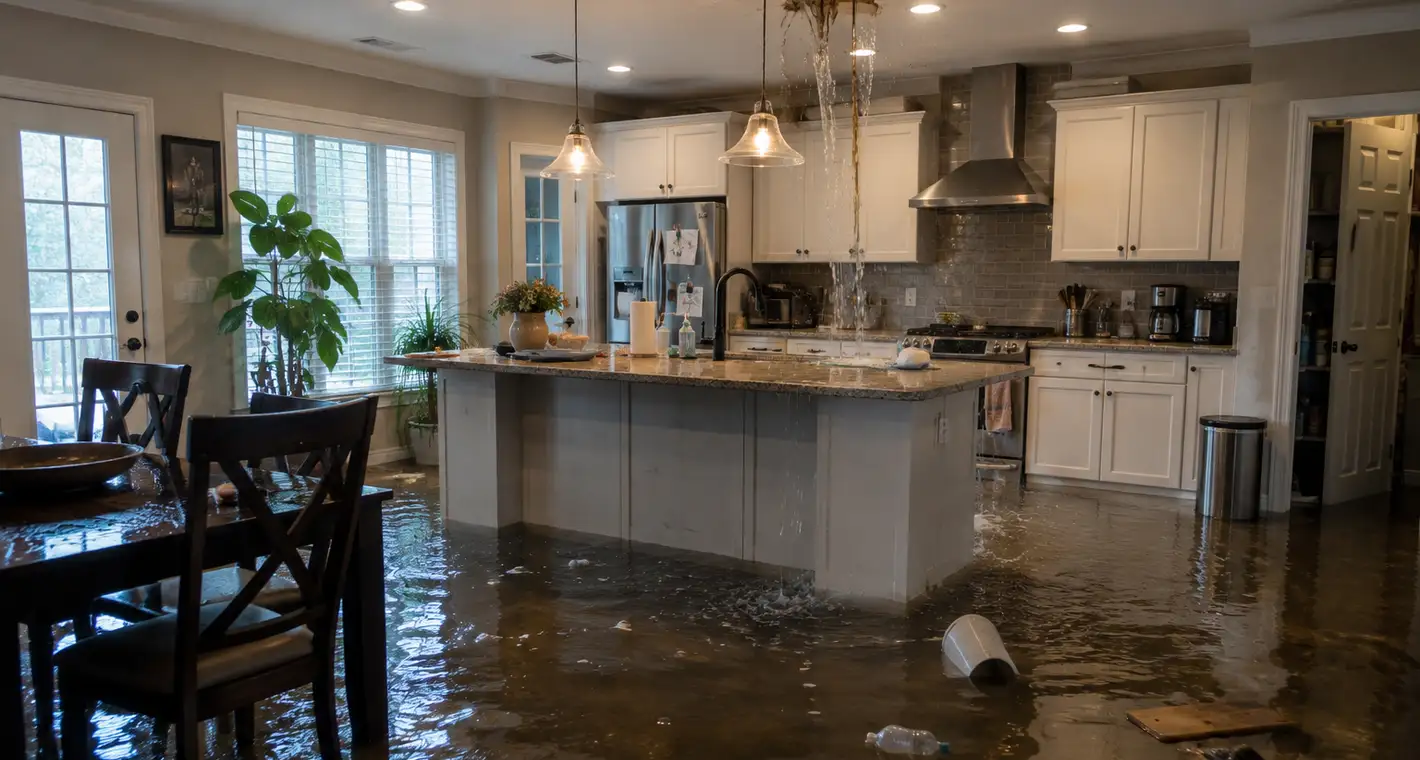
Water damage in McGregor
McGregor sits about twenty miles southwest of Waco on the western edge of the Blackland Prairie, where the ground begins to rise toward the limestone of the Edwards Plateau.
The town centre holds housing from the 1900s through the 1940s, much of it pier-and-beam with original plaster interiors, surrounded by post-war ranch construction on slabs and newer building along the highway approaches.
Before help arrives
- Shut the water off at the fixture or the main if you can reach it safely.
- Keep out of any room where water has reached outlets, cords, or the electrical panel.
- Lift furniture off wet carpet and move what you can to a dry floor.
- Photograph the damage and the failure point before anything is moved.
- Do not use a household vacuum to pick up standing water.
Common causes in McGregor
Century-old plumbing in the original town centre
Houses near the centre of McGregor date from the early decades of the twentieth century, and much of their plumbing has been replaced piecemeal rather than wholesale. That leaves sections of galvanised steel spliced to copper and to newer plastic, and the joints between dissimilar materials are where corrosion concentrates. Failures happen at the transitions rather than in the middle of a run.
Ventilated crawl spaces under older houses
Pier-and-beam construction leaves a ventilated space between the ground and the floor. It is an advantage when a house needs drying, because the underside of the subfloor can be reached directly. It is a liability the rest of the time: a leak drips into a dark, humid space where nobody looks, and Central Texas humidity keeps that space from drying on its own once the ground beneath it is wet.
Roof damage from Central Texas hail
This part of Texas sees severe thunderstorms carrying large hail most years. Hail damage to a roof does not always leak immediately; it bruises and cracks shingles that then fail weeks or months later during ordinary rain. That delay is why a ceiling stain often appears long after the storm everyone remembers, and why the connection between the two gets missed.
Thin soil over rock on the western edge
As the ground rises toward the plateau the soil layer thins over limestone, and thin soil over rock absorbs very little. Rain that would soak in further east instead runs off at the surface and concentrates in the local drainages fast. Properties on the western side of town see runoff arrive quickly and leave quickly, which is enough time to get water into a low doorway.
Drying a McGregor home
The older core of McGregor is plaster over lath on pier-and-beam, and that combination misleads people. Plaster reads dry at the face while the lath and framing behind it are still wet, so readings are taken through the assembly and from below in the crawl space rather than at the visible surface. Drying from both sides shortens the schedule considerably.
The sequence does not change from house to house: extraction first, then air movers and dehumidifiers together, with readings logged daily until materials match the dry baseline for that building. It is described in full on the water extraction and drying page.
Services available in McGregor
- Water Extraction & DryingStanding water removal and controlled structural drying under moisture readings.
- Slab Leak DamageWater surfacing through a slab-on-grade foundation, located and dried out.
- Sewage CleanupContaminated water handled with containment, removal and cleaning.
- Mold RemediationGrowth that established after water sat longer than it should have.
- Burst pipe and supply line cleanup
- Water heater and appliance leak cleanup
- Ceiling and drywall water damage
- Moisture inspection and mapping
Areas covered in McGregor
Providers cover McGregor and the surrounding area, including Downtown McGregor, Fifth Street, Highway 84 corridor, Bluebonnet, West McGregor, Oglesby Road and Coryell Street.
ZIP codes: 76657.
Frequently Asked Questions
- Will my homeowners insurance cover water damage?
- It depends on the cause rather than the damage. Policies commonly cover sudden and accidental events such as a burst supply line or a failed water heater. Damage that developed gradually from a long-standing leak, and damage from surface flooding, are typically excluded. Photograph everything before it is moved, keep any failed part, and report the loss promptly.
- Should I turn off the electricity?
- If water has reached outlets, cords, appliances, or the panel itself, treat the area as unsafe. Only shut off the breaker if you can reach the panel without standing in water. If you cannot reach it safely, leave the area and have the utility or an electrician handle it.
- A hailstorm went through months ago and now my ceiling is stained. Are they connected?
- Very possibly. Hail bruises and fractures shingles without necessarily opening a hole, and the compromised area fails later under ordinary rain or wind. That gap between the storm and the leak is normal. It matters for the claim, since the damage originates with the hail event rather than with the rain that finally brought it through, and the storm date should be established.
- What is different about drying a plaster wall?
- Plaster holds considerably more water than drywall and gives it up more slowly, and it stays structurally sound while saturated, so there is no sagging to warn you. A surface meter reading on plaster can look normal while the wood lath behind it is still wet. Readings have to be taken into the assembly, and the drying schedule runs longer than the same loss would take in a drywall house.
- There is standing water in my crawl space. Does that have to be dealt with?
- Yes. Water sitting under the house keeps the humidity in that space at saturation, and the floor structure above it, joists, subfloor and insulation, absorbs from below indefinitely. It is also the most common route to a mould problem in an older house, because the space is dark, humid and undisturbed. The water needs removing, the space drying, and whatever put it there addressing.
- My house has a crawl space rather than a slab. Is that better or worse for water damage?
- Better for drying, worse for detection. A crawl space lets a technician reach the underside of the subfloor, put airflow directly against wet framing, and confirm readings from both sides, which is not possible on a slab. The trade-off is that a leak into that space goes unseen, and the humidity down there means wet wood stays wet. Most crawl space problems are found late for exactly that reason.