
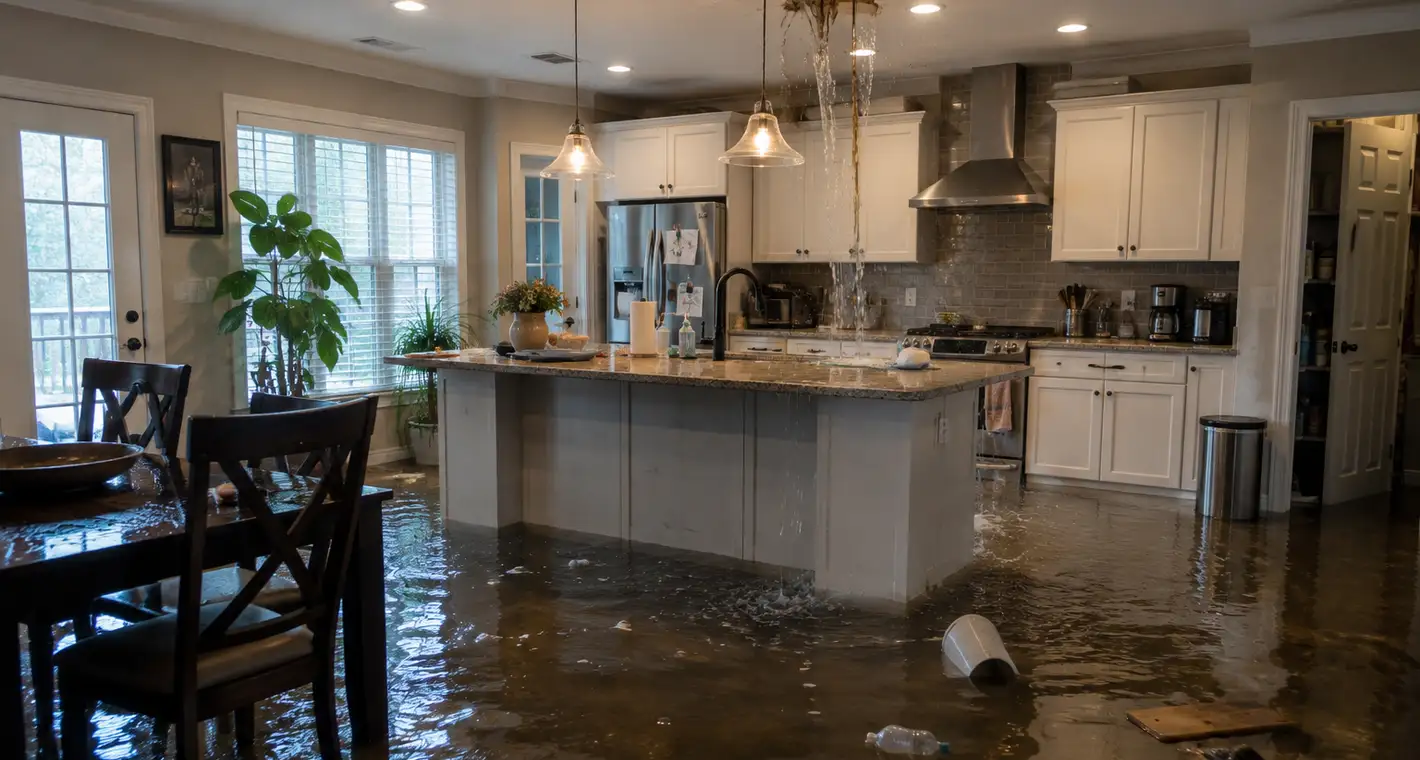
Water damage in Lacy-Lakeview
Lacy-Lakeview lies north of Waco along Interstate 35, between the Brazos River to the east and the ground rising toward Lake Waco to the west.
The city grew mainly through the 1950s and 1960s, with single-storey slab and pier-and-beam homes on modest lots, and later infill along the interstate frontage and toward the Connally area.
Before help arrives
- Shut the water off at the fixture or the main if you can reach it safely.
- Keep out of any room where water has reached outlets, cords, or the electrical panel.
- Lift furniture off wet carpet and move what you can to a dry floor.
- Photograph the damage and the failure point before anything is moved.
- Do not use a household vacuum to pick up standing water.
Common causes in Lacy-Lakeview
Sheet flow off higher ground to the west
Ground west of the city rises toward the Lake Waco area, and during heavy rain water runs off it as sheet flow across the flatter ground below. Culverts and roadside ditches sized for ordinary storms fill quickly. The result is water crossing lots at shallow depth rather than pooling in a low spot, which means it can reach a house at the front and leave at the back without anything visibly flooding.
Under-slab plumbing in mid-century homes
Homes built here in the 1950s and 1960s have had their supply and drain lines in expansive clay under a slab for six decades or more. Clay movement over that period puts repeated stress on the joints and the pipe itself. When something fails, the water surfaces through the slab or at its edge, and locating it is a matter of isolating the system and listening for it rather than looking for it.
Water heaters and laundry in interior closets
Compact single-storey plans of this era commonly put the water heater and the washer in a hallway or a closet in the middle of the house rather than in a garage. A tank failure or a burst washer hose in that position empties directly into the middle of the floor plan, with no threshold or floor drain to contain it, and water reaches several rooms before anyone notices.
Freeze failures at exposed and uninsulated runs
Housing of this vintage was built without any assumption of a multi-day hard freeze. Lines run along exterior walls, through unheated utility spaces, and out to hose bibbs with no frost protection. A pipe that freezes rarely leaks while it is frozen; the failure appears when it thaws and pressure returns, which is often while the household is out or asleep.
Drying a Lacy-Lakeview home
Small single-storey plans here tend to be one continuous space for drying purposes, with few doors to contain equipment behind and a short path from any failure to every other room. That means the affected area is usually larger than it first appears, and readings are taken across the whole floor plan rather than only around the visible wet patch.
The sequence does not change from house to house: extraction first, then air movers and dehumidifiers together, with readings logged daily until materials match the dry baseline for that building. It is described in full on the water extraction and drying page.
Services available in Lacy-Lakeview
- Water Extraction & DryingStanding water removal and controlled structural drying under moisture readings.
- Slab Leak DamageWater surfacing through a slab-on-grade foundation, located and dried out.
- Sewage CleanupContaminated water handled with containment, removal and cleaning.
- Mold RemediationGrowth that established after water sat longer than it should have.
- Burst pipe and supply line cleanup
- Water heater and appliance leak cleanup
- Ceiling and drywall water damage
- Moisture inspection and mapping
Areas covered in Lacy-Lakeview
Providers cover Lacy-Lakeview and the surrounding area, including Lakeview, Lacy Drive, Old McGregor Road area, Connally, Gholson Road, I-35 frontage and Beverly Hills area.
ZIP codes: 76705.
Frequently Asked Questions
- Will my homeowners insurance cover water damage?
- It depends on the cause rather than the damage. Policies commonly cover sudden and accidental events such as a burst supply line or a failed water heater. Damage that developed gradually from a long-standing leak, and damage from surface flooding, are typically excluded. Photograph everything before it is moved, keep any failed part, and report the loss promptly.
- Should I turn off the electricity?
- If water has reached outlets, cords, appliances, or the panel itself, treat the area as unsafe. Only shut off the breaker if you can reach the panel without standing in water. If you cannot reach it safely, leave the area and have the utility or an electrician handle it.
- The water heater is in a hallway closet. What can be done about that?
- Two things reduce the exposure without moving the appliance. A drain pan under the tank, plumbed to somewhere the discharge is visible, catches a slow failure before it reaches the floor. A leak detection shutoff on the supply to the tank closes the water automatically when it senses moisture. Neither prevents a catastrophic tank rupture, but most tank failures start as a seep rather than a burst.
- How far does water travel in a single-storey slab house?
- Further than the visible wet area, almost always. On a slab there is no floor structure to slow it, so water spreads outward under carpet pad, under vinyl plank and through the base of walls at the tack strip. It stops where friction and absorption stop it rather than at a doorway. Mapping with a moisture meter across the whole plan is what establishes the actual boundary.
- My pipes froze but nothing leaked. Am I in the clear?
- Not necessarily. Ice expanding in a pipe often splits it while the ice itself is still plugging the gap, so nothing escapes until the thaw restores pressure. That is why so many failures appear hours after the temperature has recovered. If lines were frozen, stay in the house while they thaw if you can, know where the main shutoff is, and check the attic and exterior walls once flow returns.
- Water ran across my yard but never pooled anywhere. Could it still have got in?
- It can, and this is the pattern here. Sheet flow off the higher ground to the west crosses lots at shallow depth without ponding, so there is no obvious high-water mark to point at afterwards. It reaches the house at whatever point the grade brings it to, gets in at the sill or under a door, and passes on. Check the wall base and the floor edge inside rather than looking for standing water outside.